The Search Engine Your Donors and Volunteers Are Using Has Changed
When someone wants to know how to reduce caregiver stress, which nonprofit has the best financial aid resources, or what evidence-based approaches work for youth mental health — they are increasingly getting their answer from an AI, not a list of blue links.
ChatGPT. Google's AI Overview. Perplexity. Microsoft Copilot. Claude.
These are answer engines. And unlike traditional search, they don't send users to ten options and let them choose. They synthesize an answer — and then cite the sources that informed it.
If your nonprofit isn't one of those cited sources, you are invisible in the conversation your audience is already having.
This guide explains how AI search works, why nonprofits are uniquely positioned to win at it, and what you need to do to make sure your content gets found, cited, and trusted in the age of AI-generated answers.
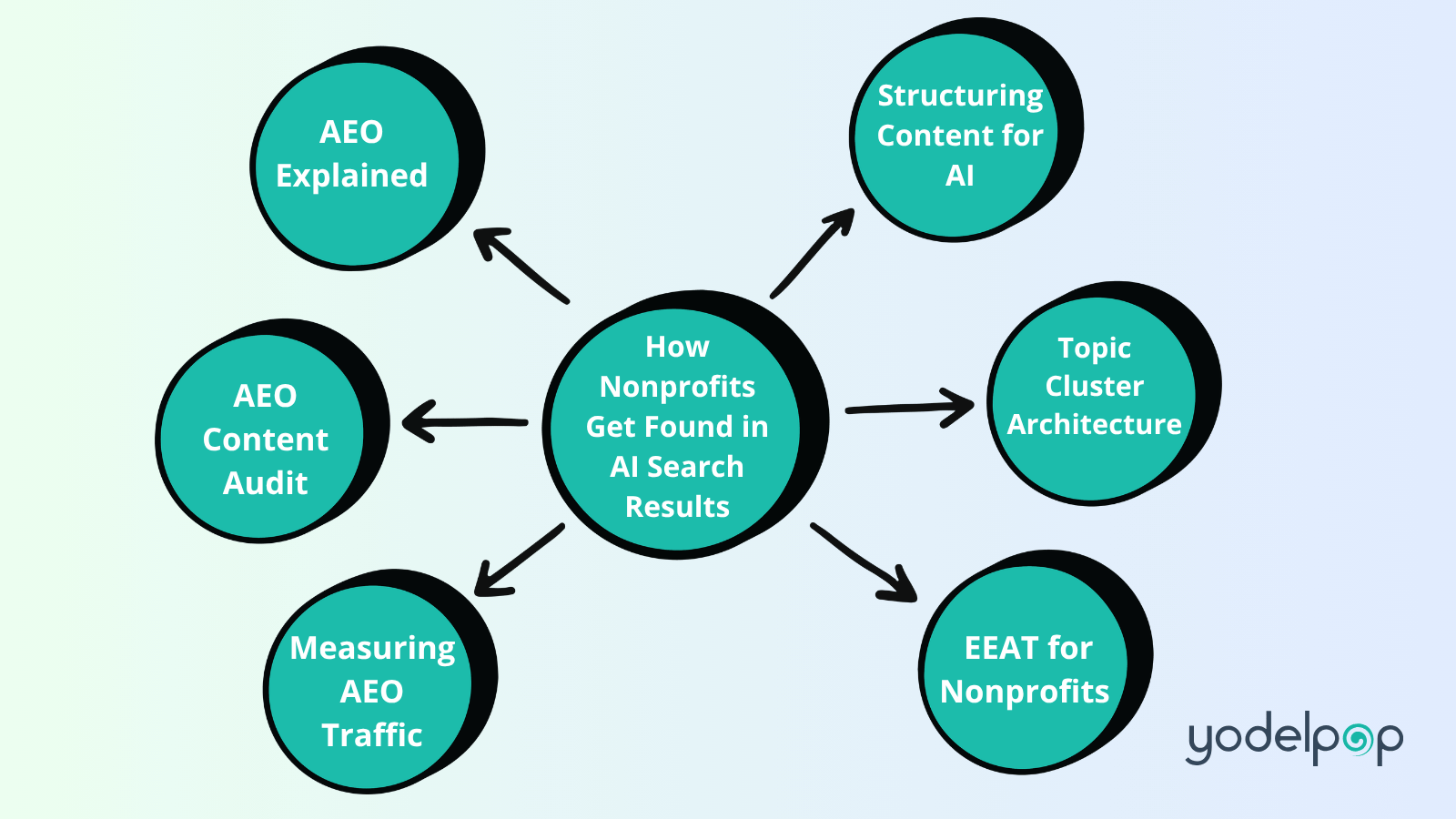
Yodelpop's AEO Content Cluster for Nonprofits — each topic links back to this guide as a supporting resource.
What Is AI Search — and How Is It Different from Google?
Traditional search returns a ranked list of pages. The user chooses where to click. Your job as a content creator is to rank high enough that they pick you.
AI search works differently. When a user types a question, the answer engine:
- Searches a vast index of web content
- Synthesizes the most credible, relevant, well-structured information into a direct answer
- Cites the sources it drew from — typically 3 to 5
This is what's known as Retrieval-Augmented Generation (RAG) — and it has enormous implications for how nonprofits should create content.
In traditional SEO, you competed for clicks. In AEO, you compete to be cited.
The result for nonprofits: Organizations that have been publishing authoritative, mission-driven, well-structured educational content for years have a significant head start. The problem is that most of that content wasn't structured for AI citation. That's the gap this guide helps you close.
💡 What is AEO?
Answer Engine Optimization (AEO) is the practice of creating and structuring content so that AI answer engines can find it, understand it, and cite it in response to user queries. It builds on traditional SEO but goes further — optimizing for how AI synthesizes answers, not just how humans click on results.
Why Nonprofits Are Uniquely Positioned to Win at AI Search
Here's something most nonprofit marketers don't realize: the criteria AI engines use to evaluate content credibility map almost perfectly to what mission-driven organizations already do.
Google's framework for evaluating content quality is called EEAT — Experience, Expertise, Authoritativeness, and Trustworthiness. It's not just for SEO anymore. AI answer engines use similar signals to decide what to cite.
Nonprofits score highly on EEAT by default:
- Experience: You work directly with the populations you serve. You have stories, data, and firsthand knowledge that a generic content farm could never replicate.
- Expertise: Your staff includes specialists — social workers, researchers, program directors, policy advocates — with credentials and depth.
- Authoritativeness: Your organization has a defined mission, a track record, and often third-party validation (grants, partnerships, regulatory status).
- Trustworthiness: You are not selling a product. Your content exists to educate and advance a mission. That signal matters to AI engines.
The problem isn't credibility. It's structure.
Most nonprofit content is written for general audiences, not for AI synthesis. It buries answers inside paragraphs. It doesn't clearly signal to an AI engine what question it's answering. It isn't connected in a way that tells the engine this organization is the authoritative source on this topic.
That's what AEO fixes.
The problem isn't credibility. It's structure.
How AI Decides What to Cite
Understanding what gets cited — and what gets ignored — is the foundation of effective AEO.
AI answer engines are looking for content that is:
1. Clearly Structured Around a Specific Question
AI engines are answer-first. They look for content that clearly identifies the question it's answering and addresses it directly — ideally within the first few paragraphs, and again in a clear, quotable format.
If your pillar page buries its main answer three scrolls down inside a dense paragraph, an AI engine will find a better-structured competitor and cite them instead.
AEO fix: Lead with the answer. Use subheadings formatted as questions. Structure content so the question and answer appear close together on the page.
2. Organized Around Topic Clusters, Not Individual Keywords
A single great blog post does not make you an authoritative source on a topic. AI engines look for coverage depth — an organization that has a pillar page on a topic and multiple supporting pieces that address subtopics and related questions.
This is why topic cluster architecture isn't just good SEO. It's the signal that tells AI engines you are a go-to authority on a subject, not a one-time publisher.
AEO fix: Build pillar pages and support them with a cluster of connected blog posts, each addressing a specific subtopic or question within the theme.
3. Written with Demonstrable EEAT Signals
Author credentials, organizational affiliations, data citations, case examples, and real-world outcomes are all signals AI engines use to evaluate source credibility. Generic content with no author, no evidence, and no specific expertise gets deprioritized.
AEO fix: Add author bios and credentials to all content. Cite data. Include real program outcomes and client examples (anonymized if needed). Make your expertise visible.
4. Technically Accessible and Crawlable
AI engines can't cite what they can't read. Content that is locked behind login walls, heavily JavaScript-dependent, or improperly structured in HTML is harder for AI engines to process.
AEO fix: Keep pillar pages and supporting content fully public, properly structured with semantic HTML, and free of unnecessary technical barriers.
5. Consistent and Current
AI engines favor content that is regularly maintained and updated. A pillar page that hasn't been touched since 2019 signals that the organization may no longer be an active voice on this topic.
AEO fix: Build content refresh into your content calendar. Updating a pillar page with new data, current examples, and fresh internal links sends a freshness signal to both AI engines and traditional search.
What EEAT Means for Nonprofit Content — and How to Optimize for It
EEAT isn't a checklist you complete once. It's a framework for thinking about every piece of content your organization publishes.
Here's how each dimension applies to nonprofit AEO:
Experience
Your organization's direct, on-the-ground experience is your strongest differentiator. Content that reflects real program work, real outcomes, and real constituent stories is something AI engines cannot easily find elsewhere.
How to signal it: Include specific program data, constituent stories (with permission), staff experiences, and year-over-year outcomes. The more specific and grounded the content, the stronger the signal.
Expertise
AI engines evaluate whether the person or organization producing content has the credentials and depth to be a trusted source.
How to signal it: Add author bylines with credentials to all blog posts and pillar pages. Reference your organization's history, research, or specialized training. Link to relevant external research that supports your claims.
Authoritativeness
This is about whether your organization is recognized as a leading voice on your topic — not just whether you've published about it. AI engines look at external signals: who links to you, who cites you, and how widely your content has been referenced.
How to signal it: Pursue editorial mentions, partnerships, and backlinks from credible organizations in your sector. Publish original data or research that others will want to cite. Guest post on industry publications with links back to your pillar content.
Trustworthiness
Nonprofits have a structural trust advantage over commercial publishers. Your content is not designed to sell — it's designed to educate and advance a mission. But trust signals still need to be visible on the page.
How to signal it: Include a clear organizational identity on every page (logo, mission statement, contact information). Cite sources. Disclose funding when relevant. Make sure your content is accurate, fact-checked, and free of misleading claims.
The AEO Content Structure: What AI-Ready Nonprofit Content Looks Like
A piece of content optimized for AI citation has a different structure than a traditional blog post or landing page. Here's what to look for — and what to fix.
The Anatomy of an AEO-Ready Content Piece
Opening paragraph: Addresses the core question directly within the first 100 words. Doesn't bury the lede. Sets up what the reader (and the AI engine) is about to learn.
Subheadings as questions: Subheadings formatted as questions ("How do nonprofits measure content marketing ROI?") help AI engines identify the specific questions your content answers and surface it for related queries.
Direct, quotable answers: Each section should contain at least one clear, standalone statement that could be cited as an answer to a question. Think of it as writing for an answer box, not just a paragraph.
Supporting evidence: Data, examples, and outcomes that validate the answer. These build EEAT credibility and give AI engines more material to draw from.
Internal links to cluster content: Links to related blog posts and supporting pages signal topic authority and help AI engines understand the full scope of your expertise.
Clear CTA: Every AEO-optimized page should have a logical next step that converts a reader who found you via AI citation into a contact, subscriber, or engaged audience member.
📋 Use this checklist to audit your existing content and structure new posts for AI citation from the start.

Topic Clusters and AI Search: Why Architecture Matters More Than Ever
If you've been publishing content for your nonprofit for more than a few years, you likely have a backlog of blogs, landing pages, and resources that exist in relative isolation — each one written for a specific keyword or occasion, but not connected in a meaningful way.
AI engines don't just evaluate individual pages. They evaluate the depth and coherence of your content across a topic.
An organization that has:
- A comprehensive pillar page on "nonprofit CRM implementation"
- Eight supporting blog posts addressing specific questions within that topic
- Internal links connecting all of it
- An author with credentials in that space
…will be cited over an organization that has one excellent blog post on the same subject, even if that post is better written.
What a Healthy Topic Cluster Looks Like for AEO
The pillar page is the definitive resource on a broad topic. It covers the full scope of the subject, links out to all cluster blogs, and is optimized for a core keyword phrase (3–5 words).
Cluster blog posts address specific subtopics and questions within the pillar theme. Each one:
- Targets a specific question or subtopic
- Links back to the pillar page
- Has its own EEAT signals (author, evidence, outcomes)
- Is structured with AEO-ready formatting
The connection between the pillar and its cluster is what tells AI engines: this organization is the authority on this topic. Not just a participant — the source.
For nonprofits, the strongest clusters are built around topics that align directly with your mission and your audience's most pressing questions. If you serve families navigating addiction recovery, your cluster isn't "addiction" — it's "how families can support a loved one in recovery." That's the specific, mission-aligned question your audience is asking, and it's one where your experience and expertise are unmatched.
How to Audit Your Existing Content for AEO Readiness
Before creating new content, it's worth evaluating what you already have. Many nonprofits discover they're closer to AEO-ready than they think — they just need to restructure and reconnect existing content rather than starting from scratch.
A Simple AEO Content Audit Process
Step 1: List your existing content by topic
Group your published blogs, pillar pages, and landing pages by theme. This reveals whether you have the foundation of a topic cluster or isolated, disconnected posts.
Step 2: Identify your highest-traffic pages
Use HubSpot, Google Analytics, or Google Search Console to find which pages are already getting traction. These are your best candidates for AEO optimization — they have existing authority that AEO restructuring can amplify.
Step 3: Evaluate each page against the AEO structure
Does it answer a specific question clearly? Are subheadings formatted as questions? Is there a direct, quotable answer within the first few paragraphs? Are there EEAT signals (author, credentials, data)?
Step 4: Prioritize your optimization sequence
High-traffic pages that need structural updates → new pillar pages where clusters have no center → new cluster blog posts to fill gaps.
Step 5: Connect everything with internal links
Add links from supporting blog posts back to the pillar page. Add links from the pillar page to cluster blogs. This is the connective tissue that makes a topic cluster visible to AI engines.
Measuring AEO Performance: How to Know If Your Content Is Getting Cited
Traditional SEO metrics — rankings, organic traffic, bounce rate — tell you part of the story. AEO adds new dimensions that require different measurement approaches.
What to Track for AEO
AI citation monitoring: Manually query AI answer engines (ChatGPT, Perplexity, Google AI Overview, Claude) using the questions your audience is most likely to ask. Is your content being cited? What is cited instead? This is currently the most direct way to measure AEO visibility.
Branded and direct traffic: When your content gets cited in an AI answer, users who want more detail often search directly for your organization or go directly to your site. An increase in branded search and direct traffic can be an indirect indicator of AI citation growth.
Organic entrances to pillar pages: Track traffic to your pillar pages specifically. Growing traffic to these pages, even as individual blog post traffic fluctuates, suggests your topic cluster is gaining authority.
Contact form and lead magnet conversions: AI-referred visitors often convert at higher rates because they've already received a synthesized answer and are seeking depth. Track conversions from pillar pages and cluster content as a proxy for high-intent AI-referred traffic.
Backlinks and external citations: When other organizations and publications begin citing your content, it amplifies your EEAT signals and increases the likelihood of AI citation. Monitor backlink growth to your pillar pages.
AEO measurement is still evolving. The tools available in 2026 are significantly better than they were 18 months ago, but manual citation checks remain the most reliable method for most organizations. Build this into your content review process biannually at minimum.
Getting Started: Your AEO Action Plan for Nonprofits
AEO is not a project with a finish line. It's a content operating system that you build incrementally and maintain continuously. Here's where to start.
If you're starting from zero:
- Identify the 2–3 topics most central to your mission and your audience's questions
- Choose one topic cluster to build first — the one where you have the most existing content and expertise
- Write or update a pillar page for that cluster using the AEO structure outlined above
- Publish or update 4–6 supporting blog posts connected to that pillar
- Add author credentials and EEAT signals to all published content
If you have existing content to work with:
- Run a content audit to map what you have to your topic clusters
- Identify your highest-traffic pages and optimize them for AEO structure first
- Build the internal link network that connects your cluster
- Fill gaps with new cluster blog posts on questions your content doesn't yet answer
- Establish a content refresh cadence — every piece of content gets reviewed annually at minimum
If you want the system to run without burning out:
AEO content requires consistency, not volume. One well-structured, EEAT-rich pillar page and four supporting cluster posts will outperform fifty disconnected blogs every time.
The key is building a content system — a Connected Marketing System — where every piece has a place, a purpose, and a path to conversion. Where content creation is driven by a clear plan, not by whatever someone finds time to write this week.
That's the difference between publishing and being found.
The Nonprofit AEO Advantage
Your organization exists to educate, advocate, and serve. You create content because your mission requires it — because the people you serve need to find you, trust you, and take action with you.
AI search doesn't change that. It amplifies it — for the organizations whose content is structured to be found.
The nonprofits that will be cited in AI-generated answers over the next five years are the ones building their content systems now. Not the ones with the biggest budgets. The ones with the clearest structure, the deepest expertise, and the most consistent commitment to publishing content that genuinely answers the questions their audience is asking.
That's a race nonprofits can win.
📋 Use this checklist to audit your existing content and structure new posts for AI citation from the start.
 Camille Winer Founder & CEO, Yodelpop
Camille Winer has been building marketing systems for nonprofits and associations since 2004 — first as an independent consultant, then as founder of Yodelpop, the certified HubSpot Solutions Partner she has led since 2011. Over more than two decades, she developed the Connected Marketing System: the methodology behind everything Yodelpop does.
Camille holds an MBA with a focus in sustainability and brings deep expertise across web development, content strategy, HubSpot implementation, and AEO-native content marketing. She is one of the earliest practitioners of Answer Engine Optimization for the nonprofit sector.