
 Marketing is changing quickly. Search is changing. AI is changing how people research and compare options. Content is being created and distributed faster. Email inboxes are harder to break through. Social platforms continue to reward experimentation.
For nonprofits, associations, and other organizations with complex audience relationships, the difficult question is not whether marketing is changing.
It is which changes actually require your attention.
Heading into 2027, the answer is not to abandon the fundamentals or chase every new platform. It is to understand how discovery and audience behavior are changing, strengthen the parts of your marketing that still matter, and build enough flexibility into your strategy to keep learning.
The fundamentals of good marketing remain recognizable: understand your audience, answer useful questions, communicate clearly, build trust, and make it easy for people to take the next step.
What is changing is where and how that journey begins.
What is changing in marketing in 2027?
Three shifts are shaping marketing heading into 2027:
- AI is becoming part of the discovery process. People can increasingly ask an AI tool a question and receive a synthesized answer instead of opening and comparing several search results themselves.
- Marketing teams need shorter feedback loops. Rapid changes in search, platforms, tools, and audience behavior make rigid long-range plans less useful than strategies that leave room to test, learn, and adjust.
- Generic information is becoming easier to produce. That makes relevance, expertise, evidence, and a clear understanding of your audience more valuable, not less.
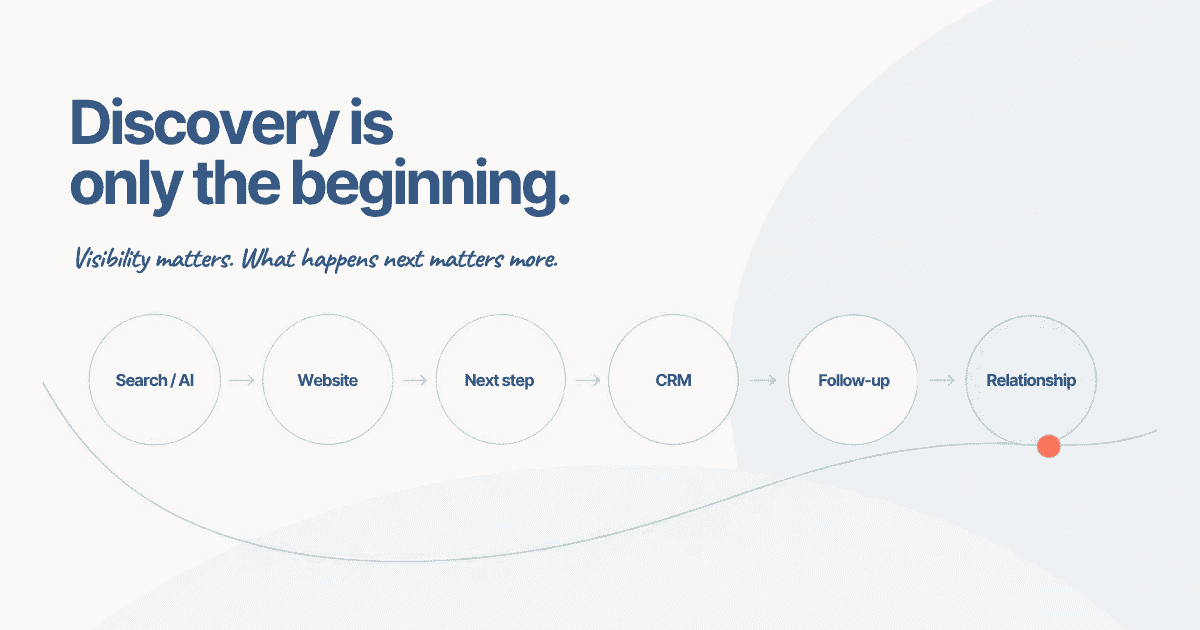
These changes affect more than content production. They affect the whole audience journey, from the first question someone asks to what they find on your website, what they understand about your organization, what they do next, and how you continue the relationship.
That is why adapting to AI-era marketing requires more than adding a few new tactics.
Is SEO still important in 2027?
Yes. Answer engine optimization, or AEO, does not replace SEO. It adds another layer to it.
SEO helps search engines discover, understand, and rank your content. AEO considers whether AI-powered search and answer tools can also understand your information well enough to use it when responding to a question.
Much of the underlying work overlaps.
A technically sound website still matters. Clear page structure still matters. Useful content still matters. Authority and evidence still matter. So does having language on your website that clearly explains what you do, who you help, and why your expertise is relevant.
What is changing is the environment in which that information may be used.
A prospective customer, donor, member, constituent, or partner may not begin by scrolling through a page of traditional search results. They may ask an AI tool a specific question and receive a summarized response before they ever reach your website.
That means your content needs to make sense not only when someone reads a page from top to bottom, but also when a search or answer engine is trying to understand a specific part of it.
What does AEO mean for your website?
AI-driven discovery makes one long-standing marketing principle even more important:
Your audience should not have to work hard to understand you.
Neither should a search or answer engine.
If your services are vague, your terminology changes from page to page, important information is buried, or different parts of your website tell different stories about your organization, that creates friction for people and makes your digital presence harder for automated systems to interpret.
Heading into 2027, take a closer look at questions like these:
- Is it obvious who we serve?
- Can someone quickly understand what we do?
- Do our most important pages answer the questions our audiences actually ask?
- Is our expertise supported with examples, case studies, results, or other evidence?
- Are important services, programs, products, or areas of expertise explained clearly on dedicated pages?
- Is our website technically healthy and logically structured?
- Once someone finds us, is the next step clear?
For nonprofits and associations, clarity extends to the mission itself.
It is not enough to repeatedly ask someone to donate, join, register, attend, or participate. People need to understand the value of the work, what makes your organization relevant to them, and why their involvement matters.
AI may be changing the mechanics of discovery, but clear positioning has become more important, not less.
AEO starts with answering better questions
Optimizing for AI does not mean filling your website with awkward questions written for robots.
It starts with understanding what your audience wants to know.
For each important audience, map the questions that appear throughout the journey.
Awareness
What is this problem? What options exist? What should I understand before deciding what to do?
Consideration
How do different approaches compare? What should I look for? What does this typically involve?
Decision
Is this organization right for me? What experience do they have? What happens next?
Then create content that answers those questions directly and thoroughly.
That might include:
- educational articles
- detailed service or program pages
- FAQs
- case studies
- customer, donor, member, or constituent stories
- comparisons and decision guides
- original research or observations
- examples from your team’s experience
- clear supporting evidence
The goal is not simply to publish more.
It is to make your organization’s knowledge easier to find, understand, and trust.
The traditional marketing funnel has not disappeared. People still move from awareness to consideration to action. What is changing is where they look for information along the way.
How should content planning change in 2027?
One of the most useful shifts for marketing teams is to shorten the planning cycle without shortening the thinking behind it.
A twelve-month content calendar can look organized at the beginning of the year and become increasingly disconnected from reality as search behavior, platforms, tools, organizational priorities, and audience needs change.
That does not mean abandoning strategy.
It means separating strategy from a rigid publishing schedule.
Your organization may still have annual goals. But the specific content, campaigns, experiments, and distribution choices used to support those goals can be planned in shorter cycles.
A quarterly or sprint-based approach gives teams more opportunities to:
- see what is actually performing
- identify new questions audiences are asking
- respond to changes in search behavior
- test new formats or channels
- improve content that already exists
- stop investing in tactics that are not producing useful results
Faster planning does not have to mean random marketing.
Every experiment should still connect to an audience, an organizational goal, and something you are trying to learn.
Does quality or quantity matter more in 2027?
It depends on the channel.
For website and educational content, quality remains essential. Publishing a high volume of thin, repetitive material creates little value for your audience and does little to demonstrate meaningful expertise.
Social media works differently. Posts have a relatively short lifespan, so a larger volume of useful experiments can help a team learn which ideas, formats, and messages connect with its audience.
Email falls somewhere in between. Sending more frequently does not make irrelevant email more valuable. But occasional generic messages are unlikely to carry an entire email strategy either.
Rather than applying one publishing rule everywhere, start by asking what each channel is supposed to accomplish.
A useful website article may continue attracting and helping people for months or years. A social post may have a much shorter window to reach someone. An email is entering a personal inbox and needs a clear reason to be there.
The goal is not maximum volume.
It is the right balance of usefulness, consistency, and experimentation for the channel.
When information is abundant, relevance matters more
AI has dramatically increased the amount of information people can access and the speed at which they can access it.
That raises the bar for generic marketing.
If your email, article, landing page, or social post could reasonably have been written for anyone, it may not feel especially useful to anyone.
Specificity becomes more valuable.
For a nonprofit marketing director, that could mean guidance designed for a small team that needs to improve visibility while also demonstrating results to leadership.
For an association, it could mean content that recognizes members may move through very different relationships with the organization over time.
For an operations leader, it could mean addressing the reality of an existing CRM investment that is not delivering enough value rather than starting with a pitch for another piece of technology.
Specificity also means bringing genuine experience into your content.
What has your team observed?
What have you built?
What have you tested?
Where have you seen organizations struggle?
What did you learn?
As generic information becomes easier to generate, useful expertise and evidence become stronger differentiators.
Keep the foundation. Test the edges.
With so much changing, it can be tempting to make every new tool or platform a strategic priority.
That is rarely realistic, especially for teams already working with limited time and competing responsibilities.
A more sustainable approach is to divide your attention between the marketing foundation you already know matters and a smaller set of deliberate experiments.
Strengthen the foundation
Focus on work such as:
- improving important website content
- addressing technical SEO issues
- making your positioning clearer
- answering audience questions more directly
- connecting content to meaningful next steps
- improving email segmentation and relevance
- using evidence and experience to strengthen your content
- making sure your data and systems support the journey you are trying to create
Test the edges
Leave room to explore:
- changing AI search behavior
- new content formats
- emerging distribution channels
- new advertising opportunities
- different publishing cadences
- AI-assisted workflows that help your team work more effectively
The point of experimentation is not to be first to every trend.
It is to learn what is useful for your audience, your goals, and your organization.
An 80/20 mindset can be useful here: invest most of your effort in strengthening and improving what already matters while reserving some capacity to test what is new.
Do not optimize discovery without thinking about what happens next
One risk in the current AEO conversation is becoming so focused on being discovered or cited by AI that the rest of the audience experience gets ignored.
Visibility is only the beginning.
Suppose someone discovers your organization through an AI-generated answer.
What happens next?
Do they land on a page that continues answering their question?
Can they understand why your organization is relevant?
Is there a useful next step?
If they fill out a form, register, donate, subscribe, or request information, does that action reach the right system?
Does your team know enough about that person to follow up appropriately?
Can you tell which content or channel contributed to the action?
At Yodelpop, we often look beyond the visible marketing problem because those connections matter.
Your audience does not experience your SEO, website, email, CRM, automation, and data as separate departments or projects.
They experience one organization.
That is why improving discovery without improving what happens after discovery only solves part of the problem.
What should organizations prioritize heading into 2027?
You do not need to rebuild your marketing program because AI exists.
You do need to look at it with fresh eyes.
Start with five questions.
1. Can the right people find us?
Review traditional search visibility, emerging AI discovery, the questions your audiences are asking, and the content you have available to answer them.
2. Can they quickly understand us?
Clarify your positioning, services, programs, expertise, mission, and the audiences you serve.
3. Are we providing something genuinely useful?
Invest in content that answers real questions with specificity, experience, and evidence.
4. Is there an obvious next step?
Connect attention to an action that makes sense for where that person is in the journey.
5. Can our systems support what happens next?
Make sure your CRM, data, automation, integrations, and internal processes support the experience your marketing promises.
Then leave enough room in the plan to test, learn, and adjust.
That will likely be more valuable than trying to predict every platform change before it happens.
The marketing fundamentals are not disappearing
There is no shortage of dramatic predictions about what AI will do to marketing.
The more useful question is what your organization should actually do differently.
Search is evolving. Audience behavior is evolving. The tools marketers use will continue to change.
But good marketing still begins with understanding people.
Know who you need to reach. Understand what they are trying to accomplish. Answer their questions clearly. Demonstrate why they should trust you. Make the next step easy. Then make sure the systems behind the experience can support the relationship that follows.
The channels are changing. The need to connect them isn’t.
Ready to take a closer look at your marketing system?
Yodelpop helps organizations connect audience strategy with content, websites, HubSpot, data, and integrations so the journey from discovery to action works more coherently.
Talk with Yodelpop about what should happen next.