
YourMembership + HubSpot Show Content Still Converts When Traffic Falls
A national professional association runs its membership in YourMembership and its marketing in HubSpot. Once we synced its YourMembership data into HubSpot, we could count the members behind each piece of content and each email. That's how we found that the association lost about a third of its search traffic to its topic content this year, but the content kept bringing in the same number of members. At the same time, we turned its member newsletter into a three-email trial for nonmembers. In the first few months it went live, 43 trial recipients have joined with paid membership.
|
Measure |
Result (as of November 16, 2026) |
|---|---|
|
Visits to topic cluster pages, year to date |
30,113, down 36% from the same period in 2025 |
|
New and renewing members connected to topic cluster campaigns |
3,117 so far in 2026, compared with 3,123 for all of 2025 |
|
Members connected to the New Membership topic cluster |
839, up from 733 |
|
Newsletter trial recipients who joined |
43 new members and 2 returning members, from about 3,085 recipients |
|
Join rate for people who asked for the trial |
about 7% (29 of 414) |
|
New members in Q3 |
219, the first quarter of 2026 to beat the year before (193) |
The Challenge
The association had spent years building a library of topic content around the careers its members work in. It had been doing its job: people found the articles in search, subscribed, and some went on to join.
Then AI search changed how people looked for answers. Many searches that used to end with a click now end with an AI summary, so pages that had performed well for years lost visits. At the same time, membership and renewals were under pressure, and the board was asking whether the content and email programs were worth the investment.
There was a second problem underneath the first. Joins, renewals and membership types all lived in YourMembership, the association's membership system, while the website, newsletter and email programs ran in HubSpot. HubSpot could show page visits and email clicks, but it couldn't show which of those people became members. Without that connection, the only numbers the team had for content were traffic numbers, and traffic was falling.
We needed to answer two questions with real numbers:
- If fewer people visit, is the content still bringing in members?
- Can the association's most visible member benefit, its monthly newsletter, do more to bring in new members?
The System We Built
- Connected YourMembership to HubSpot. We built a sync that brings the association's YourMembership data into HubSpot. Every new membership and every renewal arrives as a deal labeled New or Renewal, with its membership level and date, and each contact carries their current membership type. HubSpot now knows who is a member, who has lapsed and who has never joined, and it updates as people join and renew. Everything else in this case study depends on that connection.
- Optimized the topic content for AI search. We updated the pages in seven topic clusters, from career entry to freelancing to regulatory work, so they answer specific questions clearly and point readers to the next step, including a dedicated cluster on joining the association. We tied each cluster to a HubSpot campaign, so the YourMembership deals connected to that content could be counted.
- Redesigned the member newsletter. In April the newsletter moved to a new format, and the list went from about 8,000 to about 5,600 subscribers.
- Turned the newsletter into a trial for nonmembers. Nonmembers who already subscribed, and anyone who signs up through a new trial form, get a three-email series: a welcome to the trial, a check-in a few months later, and a last-chance email before the trial ends. The workflow uses the membership status synced from YourMembership: current members are never enrolled, and the goal is met the moment someone's YourMembership record shows they joined.
- Built persona nurture series. We wrote two new email series for three member personas: someone new to the field, someone employed in it, and a freelancer. A middle-of-funnel series (six emails per persona) launched in the spring, and a bottom-of-funnel series (four emails per persona) launched in the summer.
- Reported in members, not dollars. The association tracks revenue in YourMembership, so we built the HubSpot reporting around the number of new and renewing members connected to each piece of content and each email program.
Outcomes
Visits to the topic cluster pages fell 36% this year, to 30,113 so far, but the members connected to those topics did not fall with them. With six weeks left in the year, the clusters are already level with all of 2025.
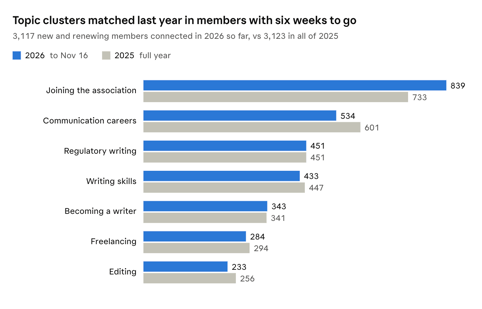
The cluster about joining the association grew the most. Regulatory writing held level, and communication careers and editing are slightly behind, with time left to close the gap.
Results: the newsletter trial
Since the trial went live in April, 43 people who received it have joined as new members, and 2 former members came back. That's out of about 3,085 people who got the welcome email.
The bigger finding is who joined. People who asked for the trial joined at more than ten times the rate of existing subscribers who were added to it.
|
How they entered the trial |
Recipients |
Joined |
Join rate |
|---|---|---|---|
|
Signed up through the trial form |
414 |
29 |
about 7% |
|
Existing nonmember subscribers, added in April |
2,671 |
14 |
about 0.5% |
|
Total |
3,085 |
43 |
about 1.4% |
- People join quickly. The median time from the first trial email to joining was 12 days, and 26 of the 43 joined within 30 days.
- They join at full membership levels. 30 chose a professional membership, 11 a professional plus freelance package, and 2 a student membership.
- The welcome email does most of the work. 36% of recipients opened it and 106 clicked. The check-in email dropped to a 15.5% open rate, and the last-chance email recovered to 27%.
Results: newsletter engagement and nurture series
The redesigned newsletter reaches fewer people but gets more of them to act. Each issue still gets about 1,600 opens, and the share of readers who click went from about 4% of openers in Q1 to about 9% in Q2 and about 7% in Q3.
Email reaches most of the people who join or renew. This year, about 6 in 10 new members and 8 in 10 renewing members had clicked one of the association's emails.
|
Program |
Launched |
Emails |
New members who joined after opening |
|---|---|---|---|
|
Middle-of-funnel nurture |
Spring 2026 |
6 per persona |
20 |
|
Bottom-of-funnel nurture |
Summer 2026 |
4 per persona |
3 |
In the middle-of-funnel series, the first two emails do best: about 30 to 35% of the people who open them click, for both the new-to-the-field and freelance personas. The bottom-of-funnel series reaches a smaller group, and it has only been running for about four months.
Ideal Fit
What it means for associations
Put your membership data where your marketing happens. YourMembership is where joins and renewals are recorded, but that data can't tell you which article or email someone read first. Once it was synced into HubSpot, every result in this case study could be measured: members by topic cluster, trial recipients who joined, and how many new and renewing members had clicked an email. It also let the automation react to membership itself, so the trial stops when someone joins and current members never get it.
Traffic is no longer the best measure of content. When AI search answers the easy questions, the visits that are left come from people who want to go further. This association lost a third of its topic traffic and still matched last year's member numbers with six weeks to spare. If it had judged the content by sessions alone, it would have cut the program that is still bringing in members.
Measure content by the members it brings in. Tying each topic cluster to a campaign let us count the members connected to it. That is the number a board understands, and it held steady while traffic fell.
A member benefit can be your best recruiting tool. The newsletter was already something members valued. Letting nonmembers try it gave them a reason to join, and the people who asked for the trial joined at about 7%. That points to where the next effort should go: getting more people to request the trial, rather than adding more people to it automatically.
Persona nurture takes time to show results. The middle-of-funnel series has been running for about eight months and has 20 new members connected to it. The bottom-of-funnel series is newer, and its numbers should be read again after a full year.