What Is Content Marketing for Nonprofits?
Content marketing is one of the most powerful tools available to nonprofits — and one of the most misunderstood.
It is not blogging for the sake of blogging. It is not posting on social media and hoping something lands. And it is not writing about your organization's news and events and calling it a strategy.
Nonprofit content marketing is a strategic process of:
- Creating and distributing valuable, relevant, and consistent content
- In order to attract and retain a clearly defined audience, and ultimately
- To drive that audience to take actions that advance your organization's mission
The distinction matters. Content marketing isn't about promoting your organization — it's about educating your audience. When you help someone understand an issue, solve a problem, or make a better decision, you become the trusted source they return to. That trust is what converts a stranger into a donor, a volunteer, or an advocate.
For nonprofits, this is a natural fit. You already have the expertise, the mission, and the stories. What content marketing gives you is the system to make that expertise findable — by the people who need it most.
Your Content Mission
Before you write a single word of content, you need to know why you're writing it.
A content mission statement defines the purpose of your content program. It aligns everything you publish with your organizational mission and ensures your content is always serving your audience — not just filling a calendar.
A useful format for nonprofit content missions:
Our mission is to [organizational mission], but when it comes to our content strategy, it's not about doing that — it's about the idea that everyone should know how to [what your audience needs to know].
An organization providing senior care might write:
Our mission is to provide high-quality assistive care with compassion and respect, but when it comes to our content strategy, it's about the idea that every family caregiver should know how to provide excellent care for an aging parent — and find the support they need to do it.
Once you have your content mission, every content decision becomes easier. You know who you're writing for, what they need to know, and why it matters. Without it, content becomes reactive — published when someone has time, on whatever topic feels relevant that week.
That's not a strategy. That's publishing.
How Search Has Changed
To understand why content marketing works the way it does today, you need to understand how people find information online — and how dramatically that has changed over the past decade.
In the early days of content marketing, the formula was straightforward: publish as many blog posts as possible, each targeting a specific keyword, and Google would reward your volume with traffic. Organizations that committed to publishing two or more blogs per week saw real results — and that approach drove a massive increase in nonprofit content programs throughout the 2010s.
That era is over.
Google and other search engines have fundamentally changed what they reward. The shift has been away from volume and toward authority. Today, the organizations that earn the most visibility are not the ones publishing the most content — they are the ones publishing the most credible, comprehensive, well-organized content on topics that matter to their audience.
The result is a search landscape that rewards:
- Depth over volume — one authoritative pillar page outperforms ten thin blog posts on the same topic
- Organization over output — content structured into topic clusters with clear internal linking signals authority to search engines
- Answers over keywords — content that directly answers the questions your audience is asking, in plain language, is what search rewards now
For nonprofits, this is good news. The new model of content marketing plays directly to your strengths: deep expertise, real-world experience, and mission-driven content that genuinely serves your audience.
The Rise of AI Search and AEO
Search has changed again — and this time the shift is bigger than any algorithm update.
AI answer engines — ChatGPT, Google's AI Overview, Perplexity, Microsoft Copilot — are now where a growing share of your audience begins their research. These tools don't return a list of links. They synthesize an answer from across the web and cite the sources that informed it.
If your content isn't structured to be cited, it is invisible in that conversation.
This is what's known as Answer Engine Optimization (AEO) — and it is the next evolution of content marketing for nonprofits.
Why AEO Matters for Nonprofits
The criteria AI engines use to evaluate content credibility map almost perfectly to what mission-driven organizations already do. Google's framework for content quality — EEAT (Experience, Expertise, Authoritativeness, and Trustworthiness) — is the same framework AI engines use to decide what to cite.
Nonprofits score naturally high on EEAT:
- Experience: You work directly with the populations you serve. Your content reflects real program work, real outcomes, and real constituent stories.
- Expertise: Your staff includes specialists with credentials and depth that generic content publishers cannot replicate.
- Authoritativeness: Your organization has a defined mission, a track record, and third-party validation.
- Trustworthiness: You are not selling a product. Your content exists to educate and advance a mission.
The problem isn't credibility. It's structure.
Most nonprofit content is not structured for AI citation. It buries answers inside long paragraphs. It doesn't clearly signal what question it's answering. It exists in isolation rather than as part of a connected topic cluster that signals authority.
What AEO-Ready Content Looks Like
Content structured for AI citation:
- Answers its core question clearly within the first 100 words
- Uses subheadings formatted as questions
- Contains direct, quotable statements that stand alone as answers
- Is organized within a topic cluster with strong internal linking
- Includes visible EEAT signals — author credentials, data citations, real outcomes
AEO and SEO are no longer separate disciplines. Every piece of content Yodelpop creates is AEO-native by default — structured to perform in both traditional search and AI-generated answers.
Want to go deeper on AEO?
Read the full guide: How Nonprofits Get Found in AI Search Results →
Keyword Research
With everything that has changed in search, you might wonder whether keyword research still matters. It does — but the way you use it has changed.
Keyword research is no longer about finding a single term to target in each blog post. It is about understanding what your audience is actually searching for, so you can build content that answers their real questions — at the right level of depth.
The tools that work best for nonprofit content marketers:
- Keywords Everywhere — installs as a browser extension and shows search volume directly in Google results. Practical and fast.
- Google Search Console — shows you which queries are already bringing people to your site. Free and invaluable.
- HubSpot's SEO tool — if you're a HubSpot user, the SEO recommendations tool helps you build topic clusters directly within the platform.
- Google's autocomplete and People Also Ask — free, real-time signals of what your audience is actually asking
One important shift: for emerging topics like AEO, search volume may be low or unmeasurable right now — not because demand doesn't exist, but because the behavior is still forming. Publishing authoritative content before demand peaks is how you own a topic when it does.
Topic Clusters: The Architecture Behind Effective Nonprofit Content
A topic cluster is a group of content organized around one core subject — a pillar page at the center, supported by a set of blog posts that address specific questions and subtopics within that theme.
This architecture does two things simultaneously:
- It tells search engines and AI answer engines that your organization is an authoritative source on this topic — not a one-time publisher
- It gives your audience a complete resource — wherever they enter your content, they can find everything they need
How to Build a Topic Cluster for Your Nonprofit
Step 1: Start with your content mission What does your audience most need to understand? The answers become your topic cluster themes.
Step 2: Choose a core topic A core topic is specific enough to be actionable but broad enough to support multiple blog posts. "Dementia care" is a core topic. "Dementia" is too broad. "How to talk to a parent with dementia" is a subtopic.
Step 3: Validate with keyword research Your core topic should have measurable search volume — typically in the thousands per month. Use this as a signal of audience interest, not a hard rule.
Step 4: Build your pillar page A comprehensive, long-form resource on the core topic. This is the authoritative page that earns visibility and converts visitors.
Step 5: Plan your cluster blog posts Each blog addresses a specific question or subtopic within the core theme. Every blog links back to the pillar page. The pillar links out to the blogs.
Step 6: Connect everything Internal links are the connective tissue of a topic cluster. Without them, you have a collection of isolated pages. With them, you have an authority signal that compounds over time.
A Real Example
An organization providing senior care built a topic cluster around dementia care — a core topic directly aligned with their mission and their audience's most pressing questions.
Their pillar page covered dementia care comprehensively. Their cluster blogs addressed specific subtopics: caregiver stress, how to talk to a parent with dementia, activities for people with dementia, stages of dementia, and more.
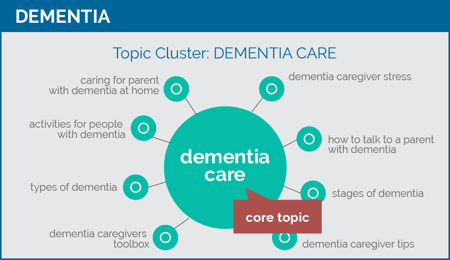
Each blog linked back to the pillar. The pillar linked out to each blog. Over time, the entire cluster gained visibility — not because of any single page, but because of the connected architecture.
That's what a topic cluster does. It makes the whole greater than the sum of its parts.
How to Create a Nonprofit Pillar Page
A pillar page is the cornerstone of a topic cluster. It is the most comprehensive resource your organization publishes on a core topic — long enough to cover the subject thoroughly, structured well enough to keep readers engaged, and optimized well enough to earn visibility in both traditional search and AI-generated answers.
What Makes a Strong Nonprofit Pillar Page
Depth and length A pillar page should be a minimum of 2,000 words — and typically much longer. Length isn't the goal; completeness is. Cover the topic thoroughly enough that your audience doesn't need to go elsewhere for the basics.
Clear structure Use a jump-link navigation at the top so readers can move directly to the section most relevant to them. Use H2 and H3 subheadings to organize content clearly. Break long sections into short paragraphs.
AEO-ready formatting Structure subheadings as questions where possible. Include direct, quotable answers near the top of each section. This is what gets your content cited in AI-generated answers.
EEAT signals Include an author byline with credentials. Cite data and external sources. Reference real program outcomes and organizational experience. Make your expertise visible on the page.
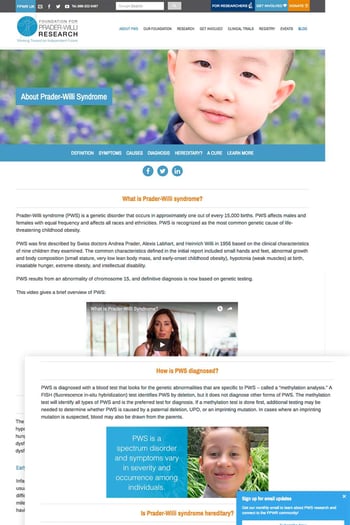
One strong diagram A visual that illustrates the topic cluster architecture — the pillar page at the center with cluster blog spokes — helps readers understand the scope of your content and gives AI engines a clear signal of topic authority.
A relevant lead magnet Every pillar page should have a click-triggered popup offering a related resource — a checklist, template, or guide — in exchange for an email address. The page earns the conversion credit in HubSpot. The lead magnet deepens the relationship.
Internal links to cluster content Link to every cluster blog post from the pillar page. This is what makes the topic cluster visible to search engines and AI answer engines.
Cluster Blog Posts: The Supporting Content That Builds Authority
Cluster blog posts are the supporting pieces that surround your pillar page. Each one addresses a specific question or subtopic within the core theme — and each one links back to the pillar.
How to Plan Cluster Blog Posts
Start with the questions your audience is actually asking. Your best sources:
- Staff who work directly with constituents — what do they get asked most?
- Email and intake form responses — what language do people use to describe their challenges?
- Google's People Also Ask — what questions surface for your core topic?
- Google Search Console — what queries are already bringing people to your site?
- Your existing blog archive — do you have isolated posts that could become cluster content with light updates and internal links?
Each cluster blog post should:
- Target one specific question or subtopic
- Be at least 800 words — enough to answer the question thoroughly
- Include an author byline and relevant EEAT signals
- Link back to the pillar page naturally within the content
- Have its own CTA — not every post needs a form, but every post needs a next step
A Note on Existing Content
If your organization has been publishing content for several years, you likely have a backlog of blog posts that exist in isolation. Before creating new content, audit what you have. Many existing posts can become cluster content with minimal updates — you may just need to add internal links, update outdated references, and restructure for AEO readiness.
Repurposing existing content is almost always faster and more effective than starting from scratch.
Getting Started
Content marketing using a topic cluster approach can feel overwhelming at first. It doesn't have to be.
Start with one cluster. Choose the topic most central to your mission and your audience's most pressing questions. Build the pillar page. Write four to six supporting blog posts. Connect them with internal links. That's a complete, functional topic cluster — and it is more valuable than fifty disconnected blog posts.
Build the habit before you build the volume. Consistency matters more than frequency. One well-structured, EEAT-rich pillar page published per quarter will outperform a blog-a-week program with no strategic architecture every time.
Connect your content to your CRM. Content marketing only compounds when it is connected to a system that captures leads, nurtures them through the buyer journey, and reports on what's working. HubSpot is the operational backbone that makes that possible — and a properly configured HubSpot portal turns your content from a publishing program into a lead generation machine.
Plan for AEO from the start. Every piece of content you create from this point forward should be structured for both traditional search and AI citation. It costs nothing extra to write an AEO-ready subheading or include a direct, quotable answer. It costs significant time and effort to go back and retrofit a year's worth of content after the fact.
The organizations that will be found — in search results and in AI-generated answers — over the next five years are the ones building their content systems now.
Start planning your first topic cluster.
Download the Nonprofit Content Marketing Planning Worksheet — a four-step fill-in guide to define your content mission, map your audience's search questions, and design your first topic cluster.